Do you sell my data?
Review the current no-sale statement, permitted sharing and the controls for your privacy choices.
Written By Landon
Last updated 1 day ago
Claim Raven’s current Privacy Policy says it does not sell consumer health data and does not sell your data for profit or any monetary transaction. It does not use VA data, claim information, uploaded records, or AI content for advertising, marketing profiles, or sale. To provide the feature you request, Claim Raven may send limited information to contracted AI, hosting, storage, payment, email, SMS, support, security, or diagnostic providers.
The Policy separately says it does not share data with marketers, advertisers, or partners; its Consumer Health Data Notice explains current provider categories, purposes, and location-dependent privacy rights.
No sale does not mean no service providers
A requested AI analysis, payment, email, text alert, support message, database record, or stored file can require a contracted provider. That limited operational processing is disclosed separately from Claim Raven's no-sale and no-targeted-advertising commitments.
What the current policy says Claim Raven does not do
- Sell consumer health data or sell customer data for profit or a monetary transaction.
- Use VA data, claim information, uploaded records, or AI content for advertising, marketing profiles, or sale.
- Use consumer health data for targeted advertising or marketing profiles.
- Share customer data with marketers, advertisers, or partners.
- Use advertising cookies or data-broker tracking. Limited analytics are described separately below.
Where limited data can still go
- Infrastructure and storage: Cloud hosting, database, file-storage, and monitoring providers may receive the information needed to host, secure, store, transmit, or diagnose the service.
- AI features: Content needed for a requested AI task may reach the commercial provider and route described in the current Privacy Policy. Provider-side retention and masking boundaries are explained in the separate AI-provider FAQ.
- Payments and communications: Stripe processes payment details; our email provider delivers email; our messaging provider delivers text alerts you enable; and our support tools carry contact-form messages to support. Each provider receives information needed for that function under its applicable contract and terms.
- Support, safety, and law: Limited information may be used or disclosed to answer a support request, investigate an error or security incident, comply with law, or enforce the Terms.
- Business transfers: The Privacy Policy separately says information may transfer as part of a merger, acquisition, financing, reorganization, bankruptcy, sale of assets, or similar transaction. A recipient remains subject to applicable law and the governing notice, and additional notice or consent is required when law calls for it.
This answer reports policy; it is not a legal classification
Privacy laws can define sale, sharing, processor, targeted advertising, and business transfer differently. This article explains Claim Raven's current policy and practices. It does not decide which law applies to a particular person, provider, contract, or transaction.
Analytics is not the same as advertising
- First-party product analytics: Claim Raven records minimized events in its own database to understand feature use. General events may use an anonymous browser identifier and, when signed in, an account ID. Query strings, fragments, free text, document or message content, condition names, and other sensitive fields are removed or restricted; health-revealing events are stored without account, visitor, session, or label identifiers.
- Google Analytics: When configured, it runs on approved public marketing and signup pages and receives ordinary website and device information. Authenticated in-app pages do not load Google Analytics by default, and the policy says Claim Raven does not intentionally send uploaded records, messages, or form free text to it.
- Advertising boundary: The Privacy Policy says product analytics are not sold or shared for advertising and that Claim Raven does not use advertising cookies or data-broker tracking. Do not read this as a claim that analytics are absent.
Use the privacy control that matches your goal
Find the consent control
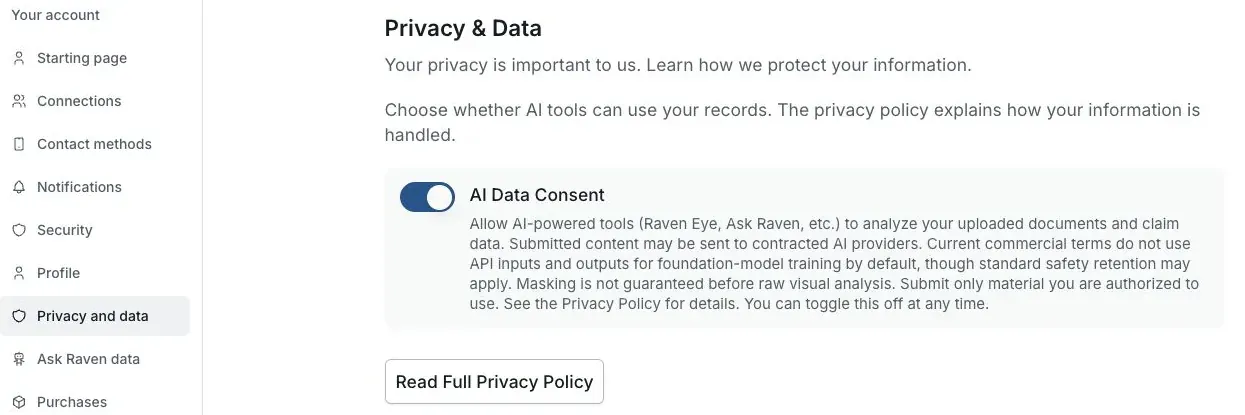
Actual Settings screen from the fictional account preview.
Review the current provider disclosure
Before using a sensitive feature, review the Third-Party Sharing and Consumer Health Data sections of the Privacy Policy. The provider list and material practices can change as capabilities and contracts evolve.
Change future consent or communications
Use the applicable AI consent control, unsubscribe link, or privacy opt-out route for your goal. Withdrawing future AI consent, unsubscribing from marketing, and asking about sale or targeted advertising are separate actions.
Ask what Claim Raven collects or discloses
Where applicable, email help@claimraven.com with the subject Consumer Health Data Request. You can ask Claim Raven to confirm whether it collects, shares, or sells covered consumer health data and request the categories, purposes, or recipient list that law requires. Identity verification and location-specific rules may apply.
Request deletion separately
Use the verified deletion process when you want covered Claim Raven records removed. A no-sale or opt-out request does not automatically delete saved files, conversations, reports, analyses, provider copies, or backups.
Current policy and government privacy sources
- Claim Raven Privacy Policy
- Claim Raven Terms of Service
- Washington Attorney General: My Health My Data Act
- California Attorney General: CCPA consumer rights
Read the current privacy commitments
Open the Privacy Policy for the current no-sale statement, provider categories, analytics boundaries, location-dependent rights, and business-transfer notice.
Useful links
- Read the Consumer Health Data Notice
- Review current operational providers
- Review cookies and analytics
- Review your privacy rights
If this does not work
You are unsure which privacy request to make
- Read the current notice and status for the action you took.
- Keep passwords, verification codes and private records out of ordinary support messages.
Describe whether you want information, an opt-out, a consent change or deletion. Ask through the Privacy Policy’s request route without attaching private records.
Related articles
Was this helpful?
Still need help? Ask the team